
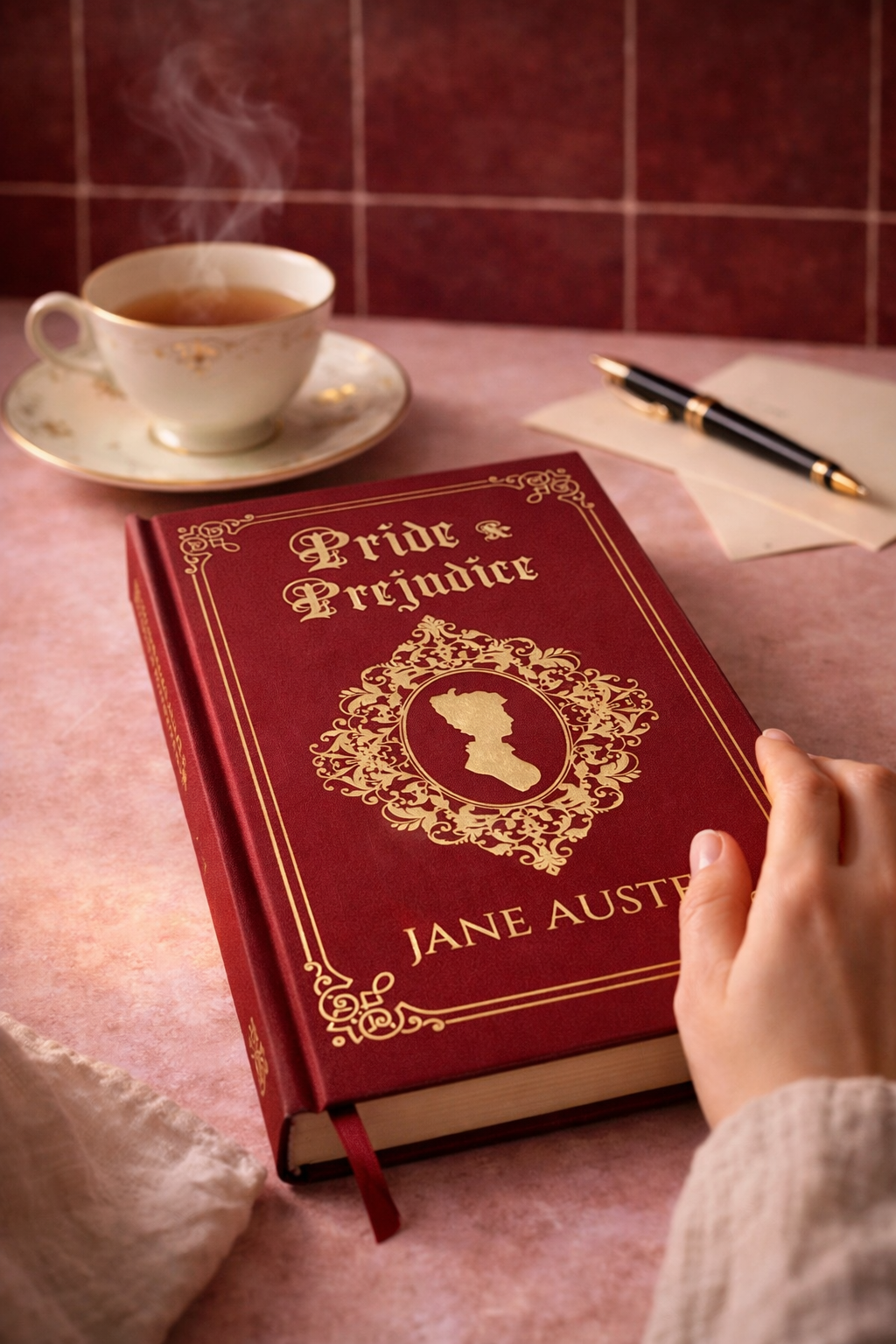
“She is tolerable, but not handsome enough to tempt me.” – Pride and Prejudice
It is not, perhaps, the most gracious sentence with which to enter a novel. Yet there it is — cool, careless, faintly amused at its own authority. One hears it almost before one sees the room: the murmur of conversation, the weight of gloved hands resting against polished wood, the small theatre of first impressions.
I have always thought that Pride and Prejudice begins not with romance, but with appetite.
Not for love — that would be too simple — but for judgement. For distinction. For the quiet pleasure of deciding what is worthy of attention and what is not. Austen’s drawing rooms are not merely social spaces; they are arenas of taste. Who speaks well. Who listens. Who observes. Who presumes.
It is a novel deeply concerned with discernment. With the cost of misreading a character. With the danger of forming conclusions too quickly or too confidently. It asks, without ever announcing the question, how one learns to see properly.
And that, I suspect, is why it belongs at the table.
A table is a place of selection. What we serve. What we refuse. How we sit. Whom we place beside whom. There is an etiquette to appetite, just as there is an etiquette to affection. In Austen’s world, to lack discernment is to risk embarrassment; to possess it is to move with quiet assurance.

Elizabeth Bennet’s intelligence is not loud. It is observant. She listens. She notices tone. She measures her responses. Even her wit is controlled — sharp, yes, but rarely careless. She understands that taste is not simply preference. It is perception.
One might say the same of a well-set table.
I often read Pride and Prejudice in the late afternoon, when the light has begun to soften and the day has lost its urgency. There is something fitting in turning its pages with a cup close at hand — steam lifting briefly, then disappearing. The novel asks to be read in such conditions. Not hurriedly. Not as an assignment. But as a company.
The rustle of paper. The quiet weight of the book resting against one’s palm. A saucer was placed gently back upon the table. These are not grand gestures. Yet they shape the atmosphere in which the story unfolds.
Literature, like dining, is a practice of attention. We return to Austen not for novelty, but for refinement — for the pleasure of observing human folly rendered with composure. She does not shout. She does not instruct. She allows her characters to reveal themselves in drawing rooms, in pauses, in misjudged remarks overheard.
There is a kind of nourishment in that restraint.
When I think of Pride and Prejudice at the table, I do not imagine spectacle. I imagine polished wood, porcelain, a dish prepared with care but without excess. Conversation measured, but alive. A room in which judgment may soften into understanding, and first impressions yield to something steadier.
The novel ends, of course, in harmony. But it begins in miscalculation. And perhaps that is why it remains so comforting: it suggests that discernment can be learned, that taste can be refined, that pride may give way to perception.
The tea cools eventually. The page is turned.
And the room, though quiet, is not empty.